Lexicon
- audience: A reading, listening or viewing public (group of people). The group of people for whom a work of design is intended.
- context: The circumstances or setting in which something exists or happens that help us fully understand its meaning.
- visual language: A set of iconic elements of a style that have been extracted and used with deliberate reference to the ideas according to which the original style was created.
- cultural hierarchy: An outdated system in which economically or culturally elite “high” culture was ranked above everyday, mainstream “middle” or “low” culture. Today, these terms are primarily used to describe form or visual languages when analyzing the meaning of a work of design.
- agenda: The underlying intentions or motives of a person or group, such as the designer/studio or client.
- function: The intended purpose or application of a design work.
Assignment Review Framework
- this framework is a core subset of the original, more detailed framework show next
- Function / subject matter
- Audience
- Main theme / concept
- Visual languages
Critique Framework
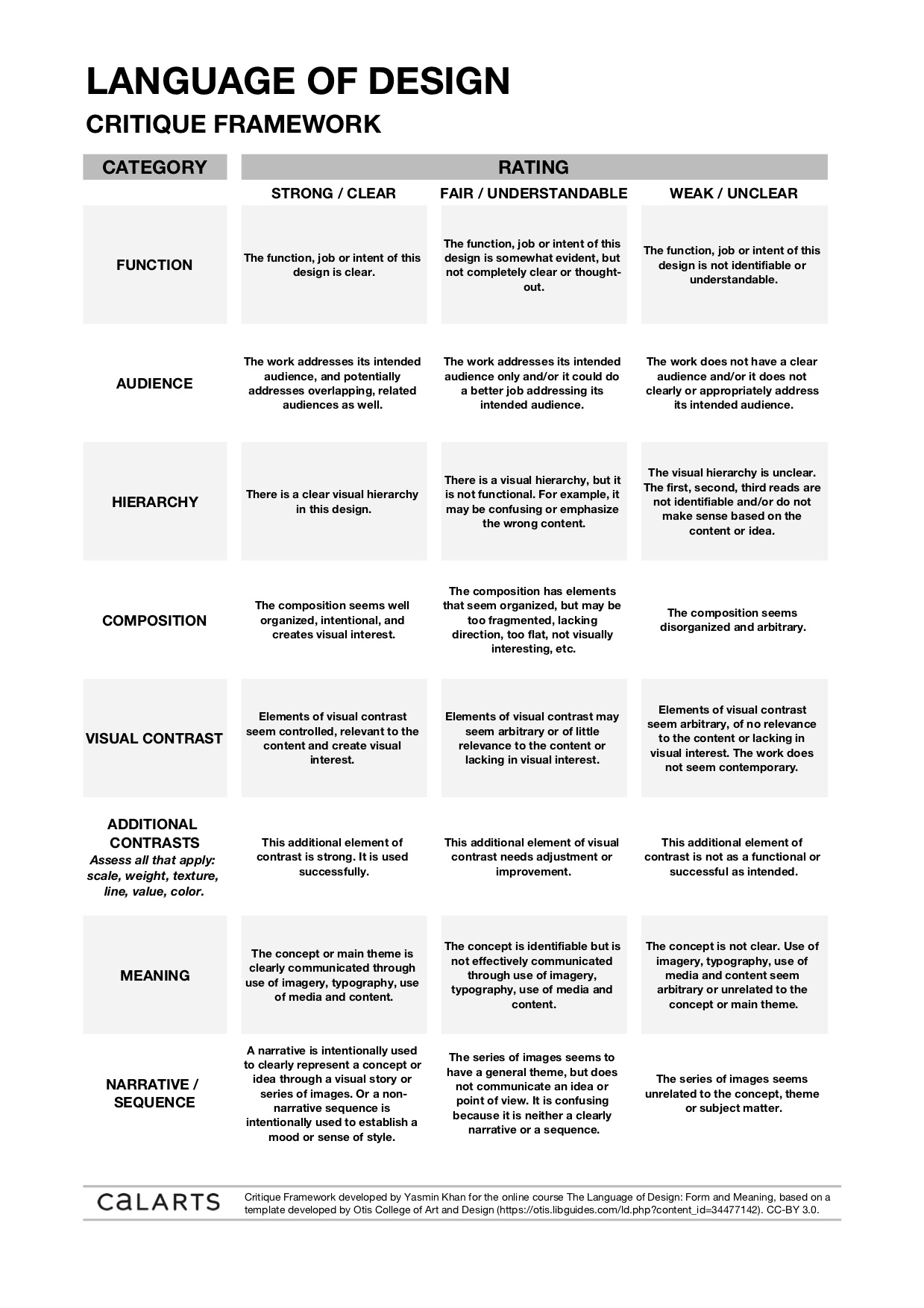
Critique Quality Rubric
- the following are used to assess how well the critique itself does:
- CLARITY: How clear were your comments, explanations, and descriptions throughout your critique?
- OBJECTIVITY: How objective were your comments, explanations, and descriptions throughout your critique?
- FOCUS: How focused do you remain on the specified areas throughout your critique?
- DETAIL/SPECIFICITY: How detailed and specific are your comments, explanations, and descriptions throughout your critique?
- ADHERENCE TO CRITIQUE FRAMEWORK: Did you provide a rating and include an explanation for your rating for each of the categories evaluated based on the Critique Framework?